
Kakobuy · Spreadsheet Routes
Shipping estimates, freight adjustments and claims
Understand why the packed parcel can change the bill, where a freight credit appears and how insurance compensation differs from an ordinary refund.
Search the product catalogue
In this guide
Start with an eligible estimate
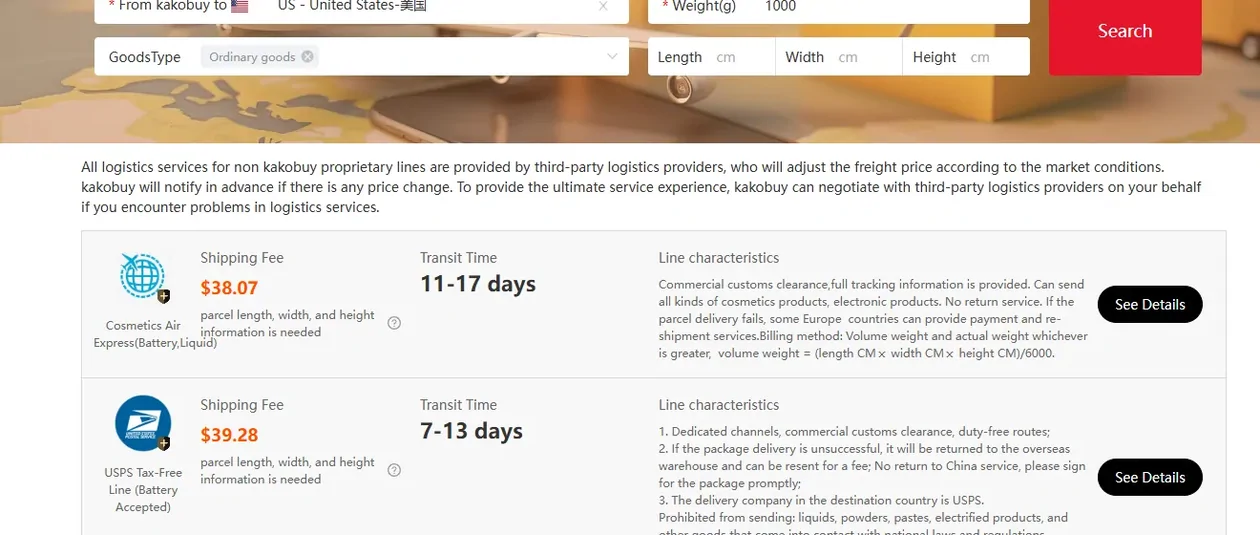
Enter the actual destination, goods type and expected packed measurements in the official estimator. Read the whole route row: price, weight rule, minimum weight, materials accepted, tracking and return-service limits. A low price for an ineligible parcel is not a usable quote.
Compare the estimate with the final parcel bill
Packing can change the measured weight and dimensions. The selected route may use actual weight, volumetric weight, rounding or a minimum charge. The item’s net weight alone is therefore not the final billed weight.
The published process describes returning excess freight to the balance after shipment and collecting a shortfall where the final amount is higher. Check the parcel’s actual adjustment and balance ledger. Do not turn a historical packing-time estimate into a guaranteed credit within 24 hours.
| If the final charge is… | What to reconcile |
|---|---|
| Lower than the paid estimate | Original freight payment, final charge, difference and balance-credit reference. |
| Higher than the paid estimate | Final chargeable weight, dimensions, rate rule, selected extras and shortfall request. |
| Unexpectedly unchanged | Whether minimum weight, volumetric billing or an added service explains the total. |
If a difference is missing or unclear, ask support for the calculation. The process may be automatic in an ordinary case, but a specific unresolved balance entry still needs investigation.
Customs charges depend on the route and destination
A duty-inclusive route describes the charges in that particular offer. It does not remove every recipient document or cooperation requirement. Keep the selected terms and ask whether an unexpected payment is included, reimbursable or your responsibility.
For payment proof, the captured agent guidance describes a payment-order screenshot rather than an invoice receipt. Check what the destination requires before ordering and ask the seller or support which documents can be supplied. Use accurate descriptions and transaction values; old threshold tables are not current customs rules.
Compensation is a separate process
The captured Kako Insurance wording offers eligible delay compensation of 20% of freight after a route-dependent 30- or 40-day threshold from shipment. It also describes customs-hold and loss/damage cover, each subject to route criteria and exclusions.
The general loss/damage basis uses actual freight plus actual goods value, within the insured amount, and deducts any earlier delay compensation from a later qualifying settlement. Exclusions include specified recipient-caused issues; delay exclusions also include several customs, weather and conflict events. Save the route policy and claim record rather than assuming every late parcel qualifies.
The uninsured article describes limits on agent responsibility for third-party transit loss or damage and carrier-claim assistance. Ask support about a trace and the applicable process. This guide does not decide the merits or payment destination of an individual claim.
Policy example: Kako Insurance terms, captured 10 October 2026. Check the current conditions for your order.
A route change needs a fresh cost comparison
If the original line rejects the packed dimensions or contents, a new line can have a different weight rule, minimum, insurance offer or return service. Compare the replacement terms before approving it. A cheaper headline rate can produce a higher total or remove a service you expected.
Keep the original payment, the revised quote and the final parcel bill as separate records. Ask whether the revision replaces an earlier amount or adds a shortfall. Do not pay the full revised total again unless the account instruction and credit record explain why that is required.
Once the final adjustment is confirmed, reconcile the debit or credit by parcel number. An item-order refund elsewhere in the balance is not evidence that this freight difference was settled. The three-record check helps locate where the transaction stops.